Language
Language grows through listening, naming, describing, questioning, storytelling, and meaningful conversation. Children benefit from hearing rich words and having time to form their own responses.
Alphabet Learning Toys• Counting Toys• Science Experiment Kits• Jigsaw Puzzles• Arts & Crafts Kits• Emotion Flash Cards• Family Conversation Cards• Chore Charts• Busy Boards.
Growth is not a race or a perfect checklist. It is a layered journey shaped by curiosity, relationships, repetition, confidence, movement, expression, and everyday participation.
This GrowWise guide helps families look at childhood development through a warm, practical, and whole-child lens. It brings together ideas for language, thinking, emotional awareness, creativity, coordination, independence, and family connection without turning ordinary home life into a rigid classroom.

Children develop through overlapping experiences rather than isolated lessons. A puzzle can support thinking and patience. A conversation card can strengthen language and emotional awareness. A chore chart can build independence while creating a stronger sense of family participation.
Language grows through listening, naming, describing, questioning, storytelling, and meaningful conversation. Children benefit from hearing rich words and having time to form their own responses.
Thinking skills develop when children compare, remember, predict, sort, count, recognize patterns, solve manageable problems, and try a different strategy when the first one does not work.
Emotional growth includes noticing feelings, developing words for them, understanding different perspectives, recovering after frustration, and learning that difficult feelings can be handled safely.
Hands-on play supports finger strength, visual attention, planning, bilateral coordination, controlled movement, and the practical confidence needed for many everyday tasks.
Independence grows through small, achievable responsibilities. Children benefit from opportunities to choose, begin, practice, complete, tidy, contribute, and ask for help when they need it.
Age ranges can be useful for organizing ideas, but they should not be treated as strict deadlines. Children may show advanced interest in one area while needing more time, repetition, or support in another.
Follow the child in front of you. Look at engagement, confidence, frustration level, communication, and readiness rather than expecting every ability to appear on an identical schedule.
Early learning often begins through sensory exploration and repeated action. Children may enjoy opening, closing, fitting, stacking, matching, pointing, naming, and watching what happens when they perform the same action again.
As attention and communication expand, children may become more interested in categories, sequences, colors, shapes, early quantities, pretend scenarios, familiar routines, and completing short multi-step activities.
Children may begin to explain their thinking, stay with longer activities, test different solutions, manage more detailed materials, follow visual routines, discuss emotions, and contribute more independently at home.
Older children may look for deeper challenges, more personal creative control, detailed experiments, thoughtful discussion, complex puzzles, independent planning, and opportunities to teach or collaborate with others.
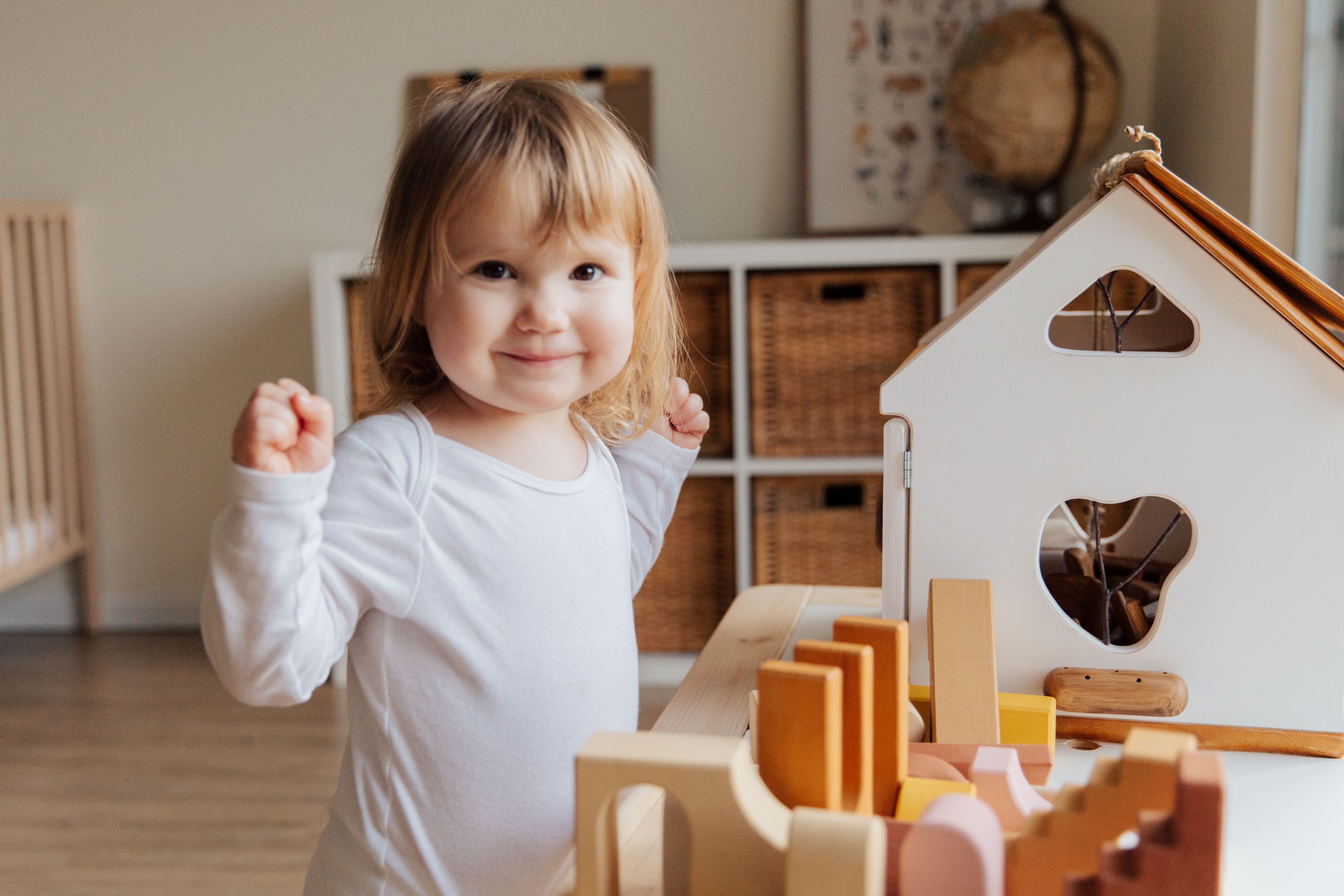
Helping does not always mean showing the answer. Sometimes the most useful support is slowing down, noticing effort, offering one small clue, simplifying the next step, or allowing a child enough quiet time to try again.
When adults immediately correct every choice, children may begin to look outward for approval instead of trusting their own observations. When adults remain available without controlling the process, children can practice agency while still feeling secure.
Use language that keeps the experience open. Try observations such as, “You moved that piece several times,” or questions such as, “What do you notice?” These responses invite reflection without turning the activity into a test.
The goal is not to remove every challenge. It is to help a child experience challenge as something that can be approached, understood, and worked through.
Children do not need a full day of structured activities. Short, predictable moments of conversation, responsibility, creative play, and shared attention can provide a rich foundation without overwhelming the family schedule.
Invite children into simple preparation. They might review a visual chore chart, choose between two clothing options, count breakfast items, or help gather what the family needs for the day.
Offer an activity that allows active discovery. A puzzle, counting set, busy board, science kit, or alphabet toy can create a focused screen-free pause without requiring a formal lesson.
Creative materials can help children process experiences in a less direct way. Encourage open-ended drawing, construction, storytelling, color choices, and crafts without requiring one perfect result.
Use emotion cards or family conversation prompts to create a calm closing ritual. Ask about something surprising, challenging, funny, kind, or interesting from the day.
The most useful activity is the one that matches a child’s current interest, available energy, and level of readiness. These nine pathways show how each GrowWise product category can support meaningful development in a different way.
Use letters for matching, sorting, sound games, name-building, tracing, storytelling, or simple scavenger hunts. Keep the experience playful and allow recognition to build gradually through repetition.
Connect numbers to real quantities by moving, grouping, comparing, and arranging objects. Ask which group has more, what happens when one is added, or how many remain after some are moved.
Before beginning an experiment, invite a prediction. During the activity, notice changes together. Afterward, ask what surprised the child and what they might test differently next time.
Encourage children to notice edges, colors, shapes, and picture details. Offer a small clue when needed, but leave enough space for the child to test possibilities and experience completion.
Use instructions as a starting point rather than a rigid standard. Invite children to choose colors, add personal details, tell a story about the finished piece, or adapt materials in an original way.
Talk about facial expressions, body clues, possible situations, and different ways people might respond. Avoid labeling one feeling as bad; focus on understanding and safe ways to handle it.
Let everyone answer, including adults. Listen without rushing to correct or teach. Follow interesting answers with gentle questions that encourage stories, opinions, memories, and imagination.
Choose a small number of clear responsibilities. Make expectations visible, recognize consistent effort, and adjust tasks as skills improve. The purpose is contribution, not perfection.
Allow repeated practice with fasteners, switches, latches, textures, and everyday movements. Repetition may look simple, but it can be deeply valuable for coordination and practical confidence.
The same activity can feel engaging one day and overwhelming the next. Readiness is affected by sleep, hunger, environment, familiarity, interest, noise, time pressure, and the emotional tone surrounding the experience.
Instead of asking only whether the child completed an activity, notice how they approached it. Their behavior can help you decide whether to simplify, pause, model, repeat, increase the challenge, or offer more independence.
Does the child return to the activity, ask questions, repeat an action, or show interest in a particular material? Engagement often reveals where learning feels naturally motivating.
A manageable challenge can support persistence. A challenge that consistently causes distress may need fewer pieces, clearer steps, adult modeling, a shorter session, or a different activity.
Repetition is not a lack of progress. Children often repeat an action while organizing information, strengthening movement, confirming an outcome, or building confidence.
Add one new element at a time. Introduce more pieces, a longer sequence, a new question, a more independent step, or an invitation to explain the child’s thinking.
Ending before an activity becomes exhausting can protect interest. A calm pause gives the child permission to return later without experiencing the activity as a failure.
We believe families deserve learning tools that support real participation without creating unnecessary pressure. GrowWise brings together screen-free products for early learning, creative discovery, emotional communication, practical routines, and meaningful time together.
These answers provide a practical starting point for using GrowWise learning tools in a calm, flexible, and family-centered way.
There is no single required session length. Follow the child’s engagement. A short, focused experience can be more valuable than a long activity that continues after interest and regulation have faded.
Not always. Children often learn through testing and noticing. Consider waiting, offering an observation, asking a gentle question, or giving one small clue before demonstrating the full solution.
Reduce the number of steps, use fewer pieces, model the first action, provide a visual example, complete part of the task together, or pause and return later. Simplifying is a way to support success, not a sign of failure.
Yes. Repetition can strengthen memory, coordination, confidence, prediction, language, and planning. The child may also discover new uses or more advanced approaches as familiarity grows.
Focus on curiosity, participation, effort, and observation rather than speed or perfect results. Offer choices, keep sessions manageable, avoid comparisons, and allow children to stop or return when needed.
Many activities can be adapted for mixed ages. One child may match or sort while another explains, counts, creates a story, asks questions, or helps organize the next step. Keep roles flexible and avoid turning the interaction into a competition unless everyone enjoys that format.
Emotion cards can help children connect facial expressions, body sensations, situations, and words. Adults can model by sharing their own age-appropriate examples and showing that feelings can be discussed without judgment.
This guide is educational and does not replace professional evaluation. Families who have ongoing concerns about a child’s development, communication, movement, behavior, learning, or emotional well-being should speak with an appropriate licensed healthcare or developmental professional.